Pages: [1]   Go Down

Author Topic: ETTR implications for HDR?  (Read 10382 times)

jnmoore

  • Jr. Member
  • **
  • Offline Offline
  • Posts: 95
ETTR implications for HDR?
« on: August 01, 2011, 02:39:29 pm »

Just finished reading Michael's excellent article re ETTR and camera manufacturers.

It struck me that perhaps my method of taking 3 exposures 2 stops apart for HDR may not be ideal? Even though my middle choice is already bumped to the right about 1 stop. Maybe 3 one stop apart and all to the right if possible. Maybe half a stop apart pusher into the right?

Would the resulting images then taken into RAW and processed further apart be better? Or am I thinking about this wrong?

John
johnagon.com

Logged

michael

  • Sr. Member
  • ****
  • Offline Offline
  • Posts: 5084
Re: ETTR implications for HDR?
« Reply #1 on: August 01, 2011, 02:46:45 pm »

Clipping is clipping. Don't clip.

The best HDR using ETTR is having one exposure to just sits below clipping and the others that reach down into the shadows.

Michael
Logged

deejjjaaaa

  • Sr. Member
  • ****
  • Offline Offline
  • Posts: 1170
Re: ETTR implications for HDR?
« Reply #2 on: August 01, 2011, 02:48:03 pm »

It struck me that perhaps my method of taking 3 exposures 2 stops apart for HDR may not be ideal?

there is an opinion that you actually need just 2 w/ 4 stops between them... the 3rd one in the middle is just because firmware does not allow to bracket the way it should (2 only).
Logged

NikoJorj

  • Sr. Member
  • ****
  • Offline Offline
  • Posts: 1083
    • http://nikojorj.free.fr/
Re: ETTR implications for HDR?
« Reply #3 on: August 01, 2011, 04:40:09 pm »

And one can add it is an argumented opinion. ;)
Logged
Nicolas from Grenoble
A small gallery

Schewe

  • Sr. Member
  • ****
  • Offline Offline
  • Posts: 6231
    • http:www.schewephoto.com
Re: ETTR implications for HDR?
« Reply #4 on: August 01, 2011, 07:15:30 pm »

And one can add it is an argumented opinion. ;)

Who are you disagreeing with?
Logged

jnmoore

  • Jr. Member
  • **
  • Offline Offline
  • Posts: 95
Re: ETTR implications for HDR?
« Reply #5 on: August 01, 2011, 09:35:19 pm »

Thanks for the reminder Michael re clipping. I went out today and practiced on a lake and sure enough the way I was doing HDR (3 exposures, what MarkII auto bracket allows, 2 stops apart) the higher exposure image was definetly clipping. I had naturally left my exposure marker for single shots to the right and need to adjust this more carefully when doing HDR. I had to "go left" with the exposure triplet to make it work. I also had to reduce, with some scenes, the 2 stops between. I need to do more shooting and processing before I can see how this will all work out.

The lesson for me is to "go left" for an exposure triplet and check high exposure clipping and adjust accordingly. I have a feeling that the 2 stops apart may not be right for many scenes.

John

Logged

ErikKaffehr

  • Sr. Member
  • ****
  • Offline Offline
  • Posts: 11311
    • Echophoto
Re: ETTR implications for HDR?
« Reply #6 on: August 02, 2011, 12:03:29 am »

Hi,

My experience is that HDR is seldom useful. The reason is mainly that with all programs I tested colors are getting messed up. The other reason is that the same information can normally retrieved from a decently exposed (ETTR) raw image. There are of course subjects that exceed the dynamic range of the sensor. Like light bulb in a dark room.

On the other hand, impressive amount of detail can gained from a picture with the controls available in LR.

I planned to write more about HDR, but I seldom found it really useful.

Some of my HDR samples are here: http://echophoto.smugmug.com/Special-methods/HDR/HDR/

The two images below are made from the same series of exposure (three exposures 2 stop apart) one is HDR the other developed in LR from -2 stop exposure.

http://echophoto.smugmug.com/Special-methods/HDR/HDR/13306153_DcZHj#1002864735_dkeci-A-LB
http://echophoto.smugmug.com/Special-methods/HDR/HDR/13306153_DcZHj#966794997_wt4h6-A-LB

Best regards
Erik

Just finished reading Michael's excellent article re ETTR and camera manufacturers.

It struck me that perhaps my method of taking 3 exposures 2 stops apart for HDR may not be ideal? Even though my middle choice is already bumped to the right about 1 stop. Maybe 3 one stop apart and all to the right if possible. Maybe half a stop apart pusher into the right?

Would the resulting images then taken into RAW and processed further apart be better? Or am I thinking about this wrong?

John
johnagon.com


Logged
Erik Kaffehr
 

ErikKaffehr

  • Sr. Member
  • ****
  • Offline Offline
  • Posts: 11311
    • Echophoto
Re: ETTR implications for HDR?
« Reply #7 on: August 02, 2011, 12:11:52 am »

Hi,

Another solution is to combine two images in Photoshop as layers, one exposed at ETTR and one exposed for shadow detail. The overexposed layer is placed on top and a layer mask applied and shadow detail is painted in. It is easier than it sounds and often works better than HDR.

The technique has been described in great detail by Michael Reichmann here on Luminous Landscape.

Often there are natural masks in a picture, check this article for some ideas:
http://echophoto.dnsalias.net/ekr/index.php/photoarticles/46-fixing-sky-with-luminosity-mask

Best regards
Erik


Just finished reading Michael's excellent article re ETTR and camera manufacturers.

It struck me that perhaps my method of taking 3 exposures 2 stops apart for HDR may not be ideal? Even though my middle choice is already bumped to the right about 1 stop. Maybe 3 one stop apart and all to the right if possible. Maybe half a stop apart pusher into the right?

Would the resulting images then taken into RAW and processed further apart be better? Or am I thinking about this wrong?

John
johnagon.com


Logged
Erik Kaffehr
 

Bart_van_der_Wolf

  • Sr. Member
  • ****
  • Offline Offline
  • Posts: 8919
Re: ETTR implications for HDR?
« Reply #8 on: August 02, 2011, 03:58:58 am »

Hi,

My experience is that HDR is seldom useful. The reason is mainly that with all programs I tested colors are getting messed up.

Hi Erik,

I beg to differ. It does require the use of a good tonemapping software though. Many people just use some presets of a program like Photomatix and slide back and forth with some of the sliders without a real grasp of what's going on, and then wonder why the image doesn't look natural and why it has wonky colors.

The tonemapping of e.g. Unified Color Technology's 32 Float doesn't produce strange colors, unless one wants to. Other strategies, e.g. in the (for Windows) SNS-HDR doesn't create strange colors either.

Quote
The other reason is that the same information can normally retrieved from a decently exposed (ETTR) raw image. There are of course subjects that exceed the dynamic range of the sensor.

Not the same. Maybe similar looking from a distance, but not the same. The moment you start pushing the shadows, the differences increase. The main benefit of an HDR is that the shadows have a much better S/N ratio. The challenge of many HDRs is how to squeeze the huge dynamic range (that's what HDR is typically used for, scenes that exceed the DR of our sensor array) into our low dynamic range output. We need tonemapping to do that.

Here are some HDR example images for experimentation.

Cheers,
Bart
« Last Edit: August 02, 2011, 04:17:09 am by BartvanderWolf »
Logged
== If you do what you did, you'll get what you got. ==

Bart_van_der_Wolf

  • Sr. Member
  • ****
  • Offline Offline
  • Posts: 8919
Re: ETTR implications for HDR?
« Reply #9 on: August 02, 2011, 06:52:15 am »

there is an opinion that you actually need just 2 w/ 4 stops between them... the 3rd one in the middle is just because firmware does not allow to bracket the way it should (2 only).

That significantly depends on the HDR compositing method used. Most methods also have to account for things like ghosting and use a weighted blend in the transition zone going from one exposure to the next. When blending with exposures that differ more than 2 stops, the increased noise contribution of the lower exposure will show, depending on the HDR compositing or exposure blending strategy.

Cheers,
Bart
Logged
== If you do what you did, you'll get what you got. ==

JohnBrew

  • Sr. Member
  • ****
  • Offline Offline
  • Posts: 868
    • http://www.johnbrewton.zenfolio.com
Re: ETTR implications for HDR?
« Reply #10 on: August 02, 2011, 08:00:48 am »

Hi,

Another solution is to combine two images in Photoshop as layers, one exposed at ETTR and one exposed for shadow detail. The overexposed layer is placed on top and a layer mask applied and shadow detail is painted in. It is easier than it sounds and often works better than HDR.


+1. Last week I made some shots of a scene and ran them (2) through PS the way Erik describes. Then, just for grins I ran the same two shots through Photomatix. The PS image was far superior. I think sometimes Photomatix tries to do too much or at least more than you need.

Guillermo Luijk

  • Sr. Member
  • ****
  • Offline Offline
  • Posts: 2013
    • http://www.guillermoluijk.com
Re: ETTR implications for HDR?
« Reply #11 on: August 02, 2011, 10:05:58 am »

That significantly depends on the HDR compositing method used. Most methods also have to account for things like ghosting and use a weighted blend in the transition zone going from one exposure to the next. When blending with exposures that differ more than 2 stops, the increased noise contribution of the lower exposure will show, depending on the HDR compositing or exposure blending strategy.

Thanks to sensor linearity, the transition zone can be made negligible as long as the relative exposures between adjacent shots are properly calculated. Unluckily most programs just look at EXIF data to find out the relative exposure, or worse, allow the user to set a EV value, therefore making progressive transitions necessary to prevent visible gaps. Funily the most accurate source for relative exposure calculation is not the metadata nor the user, but the image data itself.

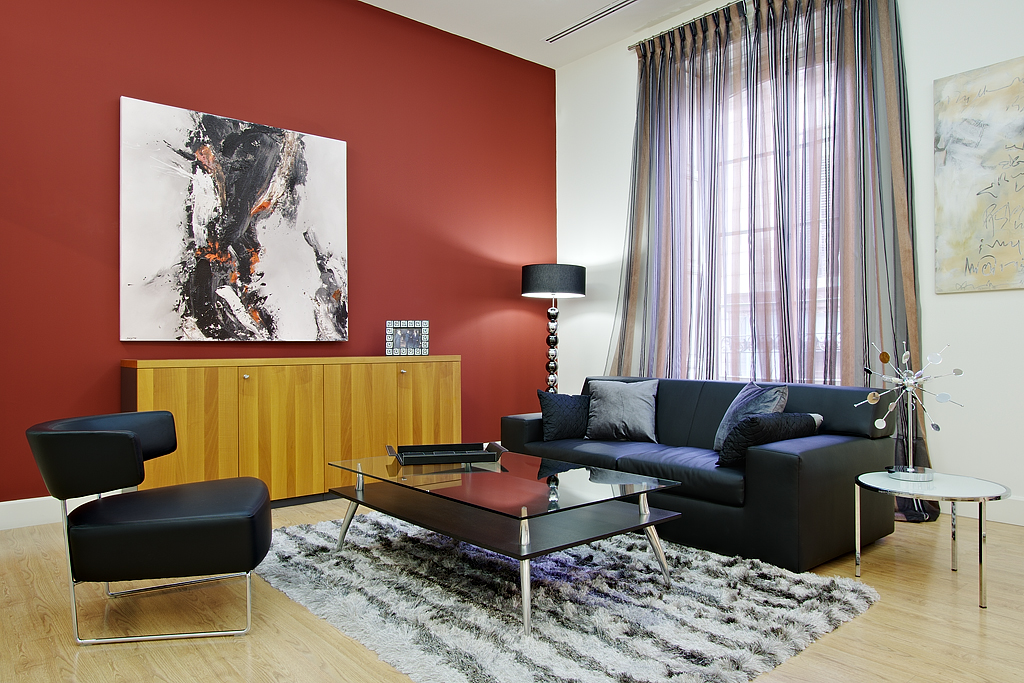
This HDR composite was done with 0 transition zones. Just correcting adjacent shots by 2EV (as the EXIF data indicated and an ingenuous user would suggest) resulted in a visible exposure gap, but an accurate relative exposure calculation of 1.93EV (just based on image pixels) provided a seamless result:
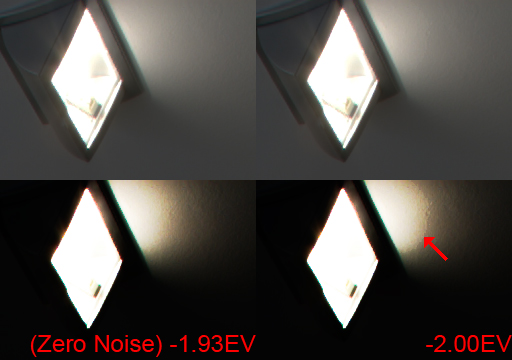


The relative exposure histograms explain why (look at the 1.93EV calculated in the first histogram):
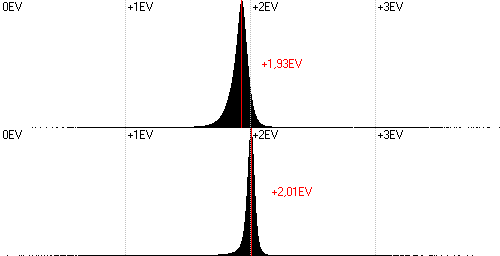


With a precise calculation, strongly fragmented non-progressive fusion maps such as this one can be used:
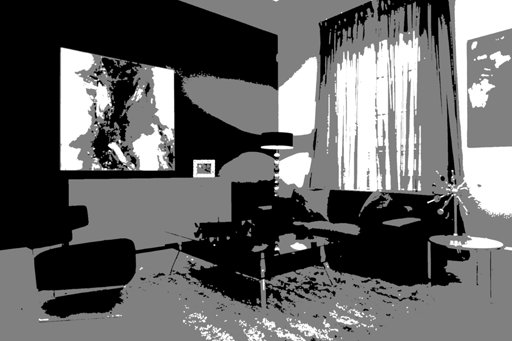

Without any risk of visible exposure gaps in the output image:


Regarding the number of shots, with current sensors there is no reason to bracket less than 3EV apart to prevent noise gaps. I prefer much more a {0, +3, +6} bracket than the classic {0, +2, +4}. Assuming both series shared the same ETTR'ed 0EV shot, the +6 shot would display about 4 times less noise than the +4 shot in the deep shadows (where read noise prevails at 6dB/EV). Unfortunately one cannot do the first bracketing in most Canons without touching the camera or using some external triggering. Bravo for Canon!.

Regards
« Last Edit: August 02, 2011, 10:45:14 am by Guillermo Luijk »
Logged

Bart_van_der_Wolf

  • Sr. Member
  • ****
  • Offline Offline
  • Posts: 8919
Re: ETTR implications for HDR?
« Reply #12 on: August 02, 2011, 02:24:01 pm »

Thanks to sensor linearity, the transition zone can be made negligible as long as the relative exposures between adjacent shots are properly calculated. Unluckily most programs just look at EXIF data to find out the relative exposure, or worse, allow the user to set a EV value, therefore making progressive transitions necessary to prevent visible gaps. Funily the most accurate source for relative exposure calculation is not the metadata nor the user, but the image data itself.

Hi Guillermo,

That's of paramount importance! The actual exposures as recorded in Raw need to be matched at the transition point.

Quote
Regarding the number of shots, with current sensors there is no reason to bracket less than 3EV apart to prevent noise gaps.

With all due respect, that is a generalization that doesn't work with all programs. It only works with a compositing technique like you do (hard transition at highlight clipping point with exact exposure matching at the transition), with low ISO Raw captures, and no ghosting removal. Many programs do not tolerate more than 2 EV difference or they will have results with increased noise, and some even sooner!

Quote
I prefer much more a {0, +3, +6} bracket than the classic {0, +2, +4}. Assuming both series shared the same ETTR'ed 0EV shot, the +6 shot would display about 4 times less noise than the +4 shot in the deep shadows (where read noise prevails at 6dB/EV). Unfortunately one cannot do the first bracketing in most Canons without touching the camera or using some external triggering. Bravo for Canon!.

Small correcion, the EOS 1 series do allow a 3 stop bracket interval between exposures. They also allow to do more than 3 exposures per bracket series (2, 3, 5, or 7 exposures). The Nikons can even do up to 9 exposures.

Cheers,
Bart
Logged
== If you do what you did, you'll get what you got. ==

Guillermo Luijk

  • Sr. Member
  • ****
  • Offline Offline
  • Posts: 2013
    • http://www.guillermoluijk.com
Re: ETTR implications for HDR?
« Reply #13 on: August 02, 2011, 02:43:04 pm »

With all due respect, that is a generalization that doesn't work with all programs. It only works with a compositing technique like you do (hard transition at highlight clipping point with exact exposure matching at the transition), with low ISO Raw captures, and no ghosting removal. Many programs do not tolerate more than 2 EV difference or they will have results with increased noise, and some even sooner!

Correct. I didn't mean all current programs could achieve that, just wanted to point that it can be achieved by putting some common sense in the coding.

This is the result of blending 2 RAW files 4 1/3 EV apart with my fusion routine. There is a visible noise gap but the program managed to perfectly calculate the correct relative exposure. Ghosting (cut leg) was removed by manually painting the fusion map:


The same 2 RAW files fed into Photomatix produced a strange result:


Small correcion, the EOS 1 series (...)

I know, that's why I said most Canons. The 7D allows for {-3, 0, +3} as well. Unfortunately my 350D and 5D only have {-2, 0, +2}.

Regards
« Last Edit: August 02, 2011, 02:55:36 pm by Guillermo Luijk »
Logged

hjulenissen

  • Sr. Member
  • ****
  • Offline Offline
  • Posts: 2051
Re: ETTR implications for HDR?
« Reply #14 on: August 02, 2011, 05:28:04 pm »

I know, that's why I said most Canons. The 7D allows for {-3, 0, +3} as well. Unfortunately my 350D and 5D only have {-2, 0, +2}.

Regards
I think that the Magic Lantern software adds more bracketing flexibility.

It seems that you are making some cool algorithms. Are these available for the public? Are you working inside some opensource raw project? I am doing some stuff in MATLAB. It would have been interesting to see how you do things.

regards
-h
Logged

Guillermo Luijk

  • Sr. Member
  • ****
  • Offline Offline
  • Posts: 2013
    • http://www.guillermoluijk.com
Re: ETTR implications for HDR?
« Reply #15 on: August 02, 2011, 06:21:01 pm »

It would have been interesting to see how you do things.

No mistery: you have 2 images A and B. Pixel (x,y) on image A has a linear value of 468, and the same pixel on image B has a linear value of 6875. What is the relative exposure between A and B? log2(6875/468)=3,88EV.

The same operation is done for the 3 RGB channels and for thousands of pixel pairs, taking the median value as the best relative exposure estimation so that noise doesn't affect accuracy (the previous relative exposure histograms spread as gaussian mainly because of noise).

Regards
« Last Edit: August 02, 2011, 06:40:27 pm by Guillermo Luijk »
Logged

jnmoore

  • Jr. Member
  • **
  • Offline Offline
  • Posts: 95
Re: ETTR implications for HDR?
« Reply #16 on: August 03, 2011, 11:24:00 pm »

Hi,

I'm amazed at the response to my simple question about how to set a camera for HDR keeping ETTR in mind. Michael was one of the few persons to offer anything useful for practice.

I'm even more amazed at the debate going on in the general discussion re Michael's article.

I appreciate the importance of research and technical analysis but it is very hard for a landscape photographer like myself to gain anything useful from these discussions.

Don't get me wrong, I think open forums and free discussions are important. My point is that the day-to-day practical aspects of shooting are largely ignored in all this ETTR discussion. I don't know what can be done, if anything, about this?

John
Logged

stamper

  • Sr. Member
  • ****
  • Offline Offline
  • Posts: 5882
Re: ETTR implications for HDR?
« Reply #17 on: August 04, 2011, 04:16:12 am »

You take what you can from the information provided. A lot of the times the technical information that the posters provide is mumbo jumbo to me as well as some egos rubbing against each other. But if you look close enough something can be learned from a practical slant. Ignore the mathematical input - some posters showing off - and look for the common sense among it. A while back when I was exploring HDR I came to the conclusion that Michael provided. There wasn't much on that part of the subject and it took a lot of posts in various forums to find out Michael's input. You notice he rarely gets involved in the verbal fisticuffs but drops in now and again with a nugget of information and the debates rattle on anew. It takes patience to split the wheat from the chaff.  ;) :)

ckimmerle

  • Sr. Member
  • ****
  • Offline Offline
  • Posts: 441
    • http://www.chuckkimmerle.com
Re: ETTR implications for HDR?
« Reply #18 on: August 04, 2011, 12:36:10 pm »

My point is that the day-to-day practical aspects of shooting are largely ignored in all this ETTR discussion.

I don't think so. Take for example the multiple suggestions or inferences that HDR is best done with one ETTR exposure, and two additional shadow exposures at either +2 or +3 stops, each. That's pretty practical.

You indicated that your base exposure was +1 stop over the meter, with 2-stop bracketed exposure on either side. That's something a lot of folks do, but is a bit less precise than the suggestions. Perhaps if you follow the advice, you'll find the better results you were hoping for.

I have no problems reading posts by those who have much more in-depth knowledge, even if they may fly over my head. If I can glean even a single new piece of information, I'm all the better for it.
« Last Edit: August 04, 2011, 12:40:23 pm by ckimmerle »
Logged
"The real voyage of discove

jnmoore

  • Jr. Member
  • **
  • Offline Offline
  • Posts: 95
Re: ETTR implications for HDR?
« Reply #19 on: August 04, 2011, 09:23:47 pm »

Point taken.

John
Logged
Pages: [1]   Go Up